
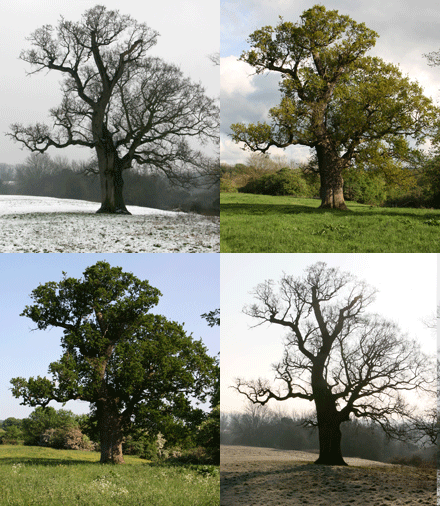
In the temperate climate of northern Europe, the changing seasons create a recurring annual cycle. Vegetation follows a corresponding pattern of growth and decline: after the relative dormancy of winter, new growth begins in spring, reaches its greatest abundance during summer, declines in autumn, and returns to dormancy in winter before the cycle begins again. This recurring sequence forms the natural basis of the year. For farming communities, the renewal of vegetation was of fundamental importance, providing crops, fruits and other resources on which subsistence depended. A failure of this renewal would have threatened the food supply and therefore the survival of the community. The continuing cultural importance of seasonal renewal can still be seen in harvest festivals and other seasonal celebrations.
As illustrated in the figure below, this cycle can be understood as consisting of two complementary phases: birth and growth, followed by decline and death. Modern Western societies often place greater emphasis on the negative aspects of decline and death, whereas cyclical conceptions of nature allow these processes to be understood as necessary stages within a continuing process of renewal.

Mahlstedt [1] argues that, in many traditional belief systems, growth and decline are not necessarily understood as opposing positive and negative processes. Instead, both form essential parts of a recurring cycle. From this perspective, decay and death do not simply represent the termination of life: they also create the conditions from which new life can emerge. Decay and death can therefore be understood as regenerative processes and as necessary preconditions for renewal.
Examples of cyclic symbols and artefacts
References
@book{Mahlstedt2004,
author = {Ina Mahlstedt},
isbn = {978-3806218398},
publisher = {Theiss},
title = {Die religiöse {W}elt der Jungsteinzeit},
year = {2004}
}