

Archaeologists use the term Funnel Beaker Culture for a group of Neolithic communities named after their characteristic pottery vessels. These beakers have a distinctive funnel-shaped upper part or neck.

The Funnel Beaker Culture (FBC), commonly abbreviated as TRB after the German Trichterbecherkultur (c. 4000–2800 BC), extended across large parts of north-central Europe. It is further subdivided into several regional groups. Its distribution stretched from parts of the Netherlands in the west, across northern Germany, to Poland in the east, and northwards into Denmark and southern Sweden.
A variety of burial practices existed during the TRB period [1]. In preceding Mesolithic traditions, burials often took the form of flat graves in which the body was placed in an extended position on its back. Single graves continued during the TRB period, but some were elaborated with wooden structures or stone settings. In general, several different forms of burial coexisted, with considerable regional and chronological variation.
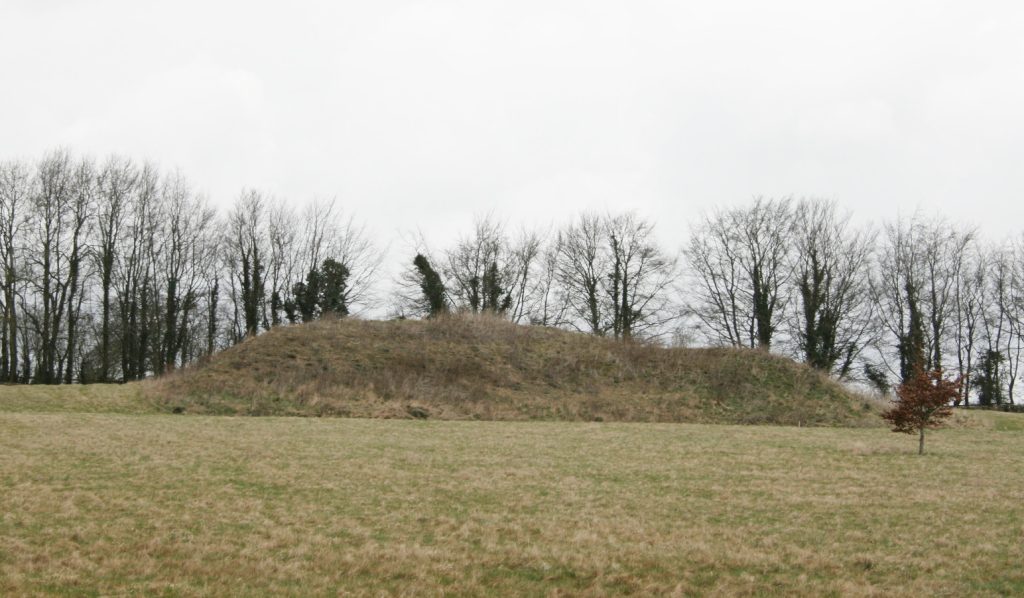
Among the earliest burial monuments associated with the TRB were non-megalithic long barrows. In north-central Europe and southern Scandinavia, these were built mainly between about 3800 and 3400 BC. Comparable long-barrow traditions also developed in Britain, outside the TRB cultural area. The structures were sometimes rebuilt or modified several times and were commonly oriented approximately east–west. At some monuments, the eastern end appears to have been associated with complex ritual practices. Finds include votive deposits and traces of fire. During later modifications, some barrows were enclosed by wooden palisades or stone settings.
There appears to have been a developmental relationship between non-megalithic long barrows and later megalithic monuments, as some long barrows contained burial cists or were subsequently modified by the addition of dolmen structures. From about 3650 BC, megalithic monuments became increasingly prominent in TRB ritual landscapes. Nevertheless, different burial forms continued to coexist, with substantial regional variation; single burials and structures incorporating timber, for example, remained in use.
Megalithic TRB burial monuments: dolmens and passage tombs
Only a small proportion of the megalithic tombs originally constructed in the core area of the Funnel Beaker Culture survives today. Müller (2017) estimated that around 5,000 monuments were still extant across northern Germany and southern Scandinavia and suggested that the original number may have approached 500,000 [1]. This very high estimate is uncertain, however. More recent surveys have substantially increased the number of known but no longer preserved monuments: around 23,000 sites are now documented across southern Scandinavia and the northern European plain, while Müller later proposed a more conservative minimum estimate of about 75,000 originally constructed megalithic tombs.
Known megalithic monuments in northern Europe
Müller & Sjögren (2022) [2] summarize the currently known megalithic monuments in the core TRB regions as follows:
| Region | Known/documented monuments |
| Denmark | 2,800 scheduled monuments + c. 7,300 additional documented examples |
| Northern Germany | 11,658 |
| Sweden | c. 550 |
| Drenthe (Netherlands) | 53 |
| Poland | c. 17 |
| Total | c. 23,000 |
These figures are not counts of monuments still standing today. They combine surviving monuments with sites known from archaeological or historical documentation. The authors emphasize that both discovery and survival rates vary strongly between regions.
Recent analyses based on radiocarbon dating indicate considerable regional variation in monument types and show that different forms were sometimes in use at the same time. Some long barrows were also subsequently modified by the addition of a dolmen. At Borgstedt in Holstein, Germany, for example, a megalithic dolmen within a round enclosure was found next to a long barrow.
Such coexistence calls into question earlier models proposing a simple chronological sequence from closed dolmens through extended and great dolmens to passage tombs, as suggested by researchers such as Sprockhoff. Instead, particular monument forms appear to have been preferred in some regions but not in others, while different forms could coexist. Müller [1] therefore suggests distinguishing the various forms of dolmen from passage tombs.

Megalithic tombs were constructed within or covered by mounds of different shapes. These include elongated long mounds, trapezoidal mounds, and round or oval mounds.
Megalithic long mounds
Megalithic long mounds were common within the TRB area, and some may, as noted above, represent later modifications of earlier unchambered long barrows.
The ‘Visbeker Bräutigam’ is a long mound enclosed by approximately 170 stones. It is about 104 m long and 8–9 m wide, with an east–west orientation. The boulders at the eastern end reach approximately 2.4 m in height. Another nearby monument, the ‘Visbeker Braut’, is about 80 m long and 7 m wide. The large boulders at its northeastern end are more than 2 m high.


Passage tombs


Waldhusen is a passage grave of the Holstein chamber type, situated near Pöppendorf, close to Lübeck in northern Germany. The monument was excavated in 1843 by K. Klug. Prior to excavation, it was covered by a mound more than 4 m high and approximately 17 m in diameter. The chamber is oriented WNW–ESE and was covered by three capstones. The central capstone has been estimated to weigh between 8 and 10 tonnes. The chamber measures approximately 4 m long, 1.7 m wide, and 1.5 m high. A narrow passage, about 2 m long and 50 cm wide, provided access to the chamber.

The gaps between the chamber stones were carefully filled with a mixture of clay and shattered flint. On the northern side, an approximately 30 cm wide opening or window was found, closed from the inside with a stone slab. A 30–40 cm thick layer of burnt wood was discovered on the chamber floor, but no bones were found. The inner faces of the stones showed traces of fire. Three ceramic vessels were also recovered from the chamber.
Several burial remains were discovered in the mound surrounding the chamber, probably representing later Bronze Age burials.
The passage tomb known as the ‘Idstedter Räuberhöhle’ is one of the relatively few monuments in Schleswig-Holstein that still survives within its covering mound.


References
[Bibtex]
@book{Mueller2017,
author = {M{\"u}ller, J.},
isbn = {9783806234633},
publisher = {Theiss, Konrad},
title = {Gro{\ss}steingr{\"a}ber, Grabenwerke, Langh{\"u}gel: Fr{\"u}he Monumentalbauten Mitteleuropas},
year = {2017}
} J. Müller and K. Sjögren, “Early monumentality in northern europe.” , 2022, pp. 1213-1233.
[Bibtex]
@InBook{Mueller2022,
pages = {1213-1233},
title = {Early monumentality in northern Europe},
year = {2022},
author = {Müller, Johannes and Sjögren, Karl-Göran},
month = {08},
isbn = {9781803273211},
doi = {10.2307/jj.15135898.89},
}